
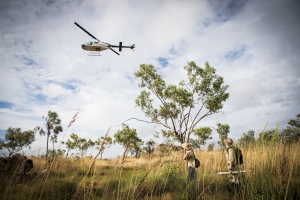
CDU researchers being dropped off in the field

Charles Darwin University (CDU) is looking for Australia’s top higher degree by research candidates with the launch of a generous project-focussed scholarship program.

The 2026/27 CDUHDR Projects with competitive scholarship opportunities are available in research fields in which the university has built a strong reputation and in areas of strategic focus, including indigenous studies, ecology, remote health, and energy.

The aim of the program is to attract high performance HDR students to the Northern Territory for a unique and rewarding research career.

It also supports the university in delivering the next generation of researchers to remain relevant in the fields that the university wants to focus on now and into the future.

We want to create a community where all our researchers are valued, supported and provided every opportunity to reach their full potential and excel in their chosen fields of research endeavor

Scholarships Available

A range of scholarship opportunities related to pre-approved projects are available to new applicants (existing HDR students will not be eligible to apply). The types of scholarships are:

Domestic applicants:

  • RTP Domestic PhD Scholarship – Standard CDU RTP stipend (approx $35,000 per annum), plus full RTP fee offset to cover the PhD tuition fees for up to 3 years.
  • DVCRCC Domestic Strategic Project Scholarship – Standard RTP stipend (approx $35,000 per annum), an additional top-up of up to @$18,000 per year, and plus full RTP fee offset to cover the course tuition fees for up to 3 years.

International applicants:

  • International PhD RTP Scholarship – RTP stipend  (approx $35,000 per annum  and CDU Graduate Full Fee Scholarship (full fee waiver) for up to 3 years NB: availability is very limited and only very high-quality applicants will be considered 
  • Graduate Full Fee Scholarship, which covers the international HDR student tuition fees only for 3 years full-time

Find out more about each project here, deadlines and how to apply here.

Successful applicants will receive a scholarship for three years to undertake a
PhD and contribute to CDU strong research culture.

Research excellence through application

Charles Darwin University (CDU) is a research-intensive university with outstanding performance and recognised excellence in Indigenous and tropical health, environmental science and public policy. Our research portfolio has real-world impact, well beyond our unique location in northern Australia.

The majority of CDU’s research is conducted through research institutes that have increased our researchers’ exposure and collaboration opportunities. Our research institutes include Menzies School of Health Reserarch, the Research Institute for the Environment and Livelihoods, the Northern Institute, the Energy and Resources Institute,  However, our research spans across education, business, law, indigenous futures, creative arts, psychology, health and human sciences, engineering, and IT.

Why do research at CDU?

Strong administrative support

The Office of Research and Innovation (ORI) is a CDU department staffed by research administration experts who help our researchers with issues, such as ethics in research, academic acknowledgement, grant applications, research communication, and HDR and scholarship administration.  In fact, it’s through ORIs efforts that CDU can offer these scholarships.

High research output

CDU is the smallest university in Australia, but punch well above its weight in research output.  That’s because CDU has strong support for research at the university, which is promoted through events such as the HDR conferences, and three-minute thesis events.

Supervisor support

Our supervisors are some of the most distinguished researchers in their field.  We have students from around the world study at CDU because of the opportunity to be mentored by our research leaders.  We are a university that’s small enough for intensive supervisor support, but large enough to have outstanding support and opportunity.

Multi-disciplinary approach

At CDU, we encourage a multi-disciplinary approach to research to enhance collaboration and to broaden research outcomes.  Through collaboration researchers can put their research into context and address complex issues, such as how to apply your research in a remote environment.

Regional approach, global outcomes

We focused on outcomes for Northern Australian communities and our research is embedded with the people of the region, but our outcomes are also relevant for similar communities and environments around the globe.  It’s why CDU has strong partnerships with research institutes, governments and universities across Asia, and our researchers collaborate on projects around the world.

Adventure

Northern Australia is one of the most unique and unspoiled places on earth.  The environment and the people leave an endearing and lasting impression on our researchers.  It’s a place for discovery both personally and professionally as a researcher.

Lab experiment

Respect for CDU’s research

CDU has been acknowledged as a research-focuses institute that take outcomes that have real impact on the people, environment, policy and communities across Northern Australia and the global community.

  • CDU in the top 200 universities from around the world (Times Higher Education Impact Rankings).
  • 23 academics named in The Stanford University and Elsevier World’s Top 2% Scientists list in 2023.

Influential researchers

CDU might be small, but we have a cohort of researchers who are some of the most influential in their fields.  According to a Standford University study into citation numbers of 100,000 past and present researchers, CDU and Menzies has 24 researchers in the top 2% of influential researchers in their fields, such as ecology, applied physics, accounting, general and internal medicine, nursing, environmental engineering, and artificial intelligence.

Impact ranking 

CDU researchers work is a challenging environment, that is relevant for other developing regions around the world.  That’s why the university is recognised for its research contribution when it’s evaluated on the United Nations’ Sustainable Development Goals (SDG), where we rank within the top 200 of the 1799 universities included in the ranking.  Our strength is in the SDG of good health and well-being where we rank as the 18th best university in the world,